Are Air Fryers More Economical Than Ovens?
Yes, for small batches. An air fryer is usually more economical than a full oven because it heats a small basket fast and runs for less time, so it uses less energy per meal. A large oven wins when you fill it with a big tray or several dishes at once.
On this page (8 sections)
- Are air fryers more economical than ovens for small meals?
- How does the wattage compare with a normal oven?
- How do cooking times change the total energy used?
- When does a full oven win on running cost?
- How can you measure the real running cost at home?
- How does an air fryer compare with a microwave on energy?
- Is an air fryer just a small convection oven?
- So, are air fryers more economical than ovens?
Yes, for small batches. An air fryer is usually more economical than a full oven because it heats a small basket fast and runs for less time, so it uses less energy per meal.
A large oven wins when you fill it with a big tray or several dishes at once.
The short version is that a 1,725W air fryer draws similar power to an oven while its element is on. The difference is how long each one stays on to cook the same food.
Are air fryers more economical than ovens for small meals?
Yes, clearly. A single serving heats quickly in a small basket, and an air fryer like the Cosori TurboBlaze 6 Qt reaches temperatures up to 450°F with a 3600 rpm fan that pushes heat straight onto the food.
An empty full-size oven heats a much larger cavity before your food even starts cooking.
That smaller space is the whole story. The air fryer's element only has to warm a few litres of air, so less energy escapes into the room as lost heat.
The basket itself is a square design with usable space of roughly 9.3 by 9.3 inches, so the hot air stays close to the food rather than spreading through a wide box.
Most oven recipes also ask for a long preheat. An air fryer often needs none at all, and the Cosori even makes preheat adjustable so you can skip it when you're in a hurry.
Skipping 10 to 15 minutes of heating a large oven is where the saving adds up. Its temperature dial also starts as low as 90°F, which suits gentle jobs like proofing dough or drying herbs without running the full element hard.
How does the wattage compare with a normal oven?
The wattage rating only sets the power draw. The Cosori TurboBlaze runs at 1,725 watts, and what decides the bill is how long it stays switched on.
Power per minute is only part of the picture.
The real difference is duty cycle. An oven's element switches on and off to hold temperature in a large cavity, so it keeps drawing power for the whole bake.
An air fryer's fan circulates heat in a small space and the element rests more often. The Cosori's five fan speeds are part of this: at a lower speed the element cycles less aggressively, while the top speed moves air hard enough that food browns without the element running flat out the entire time.
Wattage alone tells you little about the bill. Two appliances with the same rating can differ hugely if one runs for 12 minutes and the other for 45.
That's why a plug-in monitor is more useful than comparing labels. A 1,725W rating is simply the ceiling, not the average draw over a cook.
How do cooking times change the total energy used?
Total time switched on decides most of the cost. A small batch of fries might take 12 to 18 minutes in an air fryer, while an oven needs a long preheat plus a longer bake to get the same crispness.
Even at equal wattage, the shorter run uses less.
The Cosori's timer runs from 1 minute up to 24 hours, so long slow jobs like drying or proofing are possible without leaving the element at full heat. That flexibility matters for energy, because you can match the run time to the job instead of heating a big oven for hours.
Cooking volume is the next factor. If you're feeding one or two people, the air fryer's 6-quart basket covers the meal in one go.
The basket holds around 20 chicken wings with the crisper plate in place, which is a full family portion in a single run. Repeating a basket several times for four or five people erases much of the advantage.
Add up the minutes, not the wattage. Three 15-minute air fryer batches is 45 minutes of running, which is close to a single oven bake.
Batch size is the honest way to judge which is more economical.
When does a full oven win on running cost?
When you fill it. A large oven baking several trays, a big roast and a side dish together spreads one heat-up across many servings.
That is efficient in a way an air fryer basket can't match at family scale.
The Hamilton Beach Easy Reach Convection Oven is a useful middle option. It's a countertop convection oven with a 16-litre interior that fits a 5 lb chicken, a 12-inch pizza or a 9 x 11 inch bake pan.
It heats a smaller cavity than a full oven and runs 150 to 450°F.
Hamilton Beach says convection reduces cooking time by up to 25 percent. If that holds for your recipes, a compact convection oven can undercut a full oven on long bakes while still fitting more than an air fryer basket.
Its roll-top door also swings up and out of the way, so you can reach in mid-bake without pulling the rack out and losing heat.
When should you pick the air fryer over the oven?
Pick the air fryer when most meals are one or two servings and you want speed. It's also the better choice when you'd rather not heat the kitchen on a warm day.
For a full breakdown of how the two cook, see our air fryer vs oven comparison.
When should you pick the oven or convection oven?
Choose the oven when you cook in bulk, bake cakes and bread, or need several dishes hot at the same time. A countertop convection model suits small kitchens where a full oven feels oversized.
If you're weighing a glass-bowl cooker instead, our halogen oven vs air fryer guide covers that trade-off.
How can you measure the real running cost at home?
Use a plug-in electricity monitor. The P3 P4400 Kill A Watt connects between the socket and the appliance and counts consumption by the kilowatt-hour, the same unit your utility bills in.
It can show use by day, week, month or year.
Run the same meal in the air fryer for a week and in the oven the next week. Compare the kilowatt-hour totals rather than guessing from wattage labels.
The monitor also checks voltage and power factor, so you can see how hard the appliance really works. A soft start feature on the Cosori's motor means the first moments of a cook draw less than a hard jolt would, and the monitor will show that in the running total.
Use one monitor and swap it between appliances, since it's rated for 115-volt appliances up to 15 amps. That covers most air fryers and countertop ovens.
How does an air fryer compare with a microwave on energy?
A microwave usually uses less energy for reheating. It heats food directly and runs for a few minutes, so for leftovers and defrosting it stays the cheapest option.
An air fryer uses more energy but gives you crispness a microwave can't.
Think of the three as a ladder. The microwave is cheapest for reheating, the air fryer sits in the middle for small crisp meals, and the full oven costs most per batch unless you fill it.
Pick the tool that matches the job rather than running one appliance for everything.
Our air fryer vs microwave comparison explains when each one earns its place on the counter. The energy answer follows the same logic as the cooking answer.
Is an air fryer just a small convection oven?
Basically yes. An air fryer is a compact convection oven with a strong fan and a basket instead of a rack.
That's why its running cost sits so close to a convection oven's per minute, and why it heats faster than a full oven.
The Cosori TurboBlaze proves the point with its 3600 rpm fan and five fan speeds, features a convection oven would recognise. Its basket is smaller, so less air needs heating.
The 53dB noise figure on its top speed is a side benefit of that design, since a fan tuned to run quietly tends to waste less energy as vibration and sound. Our guide to whether convection ovens and air fryers are the same goes deeper.
Knowing this helps you choose. If you already own a convection oven with a good fan, a separate air fryer saves energy mainly through its smaller size, not some secret technology.
What else does the smaller basket change?
Beyond energy, the smaller basket changes cleaning and counter space. The Cosori's ceramic-coated basket and crisper plate are dishwasher-safe, so there's no scrubbing a big oven rack.
Its footprint is about 14.4 inches deep by 11.8 wide, which leaves counter room free when it's not in use.
So, are air fryers more economical than ovens?
For most everyday cooking, yes. If your meals are one or two servings, an air fryer heats a small basket fast and runs for less time than a full oven, so it uses less energy overall.
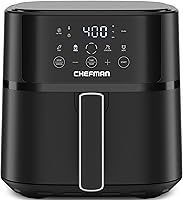
The Cosori TurboBlaze 6 Qt, at 1,725 watts and 6 quarts, covers family meals while keeping the cavity small.
A full oven or countertop convection oven takes the lead when you cook in volume. The Hamilton Beach Easy Reach Convection Oven heats a 16-litre space and fits a 5 lb chicken or a 12-inch pizza in one batch.
If you want proof for your own kitchen, the P3 P4400 Kill A Watt measures it in kilowatt-hours.
The economical choice depends on how you cook, not on which appliance is smaller. Measure a week of real meals with the monitor and the answer for your kitchen becomes clear.
Frequently asked questions
Does a smaller wattage always mean lower running cost?
No. Wattage only sets the power draw while the element runs.
The bigger factor is total time switched on, so a lower-wattage oven that preheats for 15 minutes can use more than a higher-wattage air fryer cooking for 12.
When is a full oven cheaper to run than an air fryer?
When you fill it. Cooking several trays or a large roast in one oven heat-up uses less energy than running an air fryer basket several times in a row for the same food.
Batch size decides it more than wattage.
Can I measure how much electricity my air fryer uses?
Yes. A plug-in electricity monitor like the Kill A Watt connects between the wall socket and the appliance and counts consumption in kilowatt-hours.
You can then compare a week of air fryer meals with the same meals cooked in the oven.
Do air fryers use less electricity than a halogen oven?
Often, because the basket is smaller and heats faster. A halogen oven has a larger glass bowl and a bulb that takes longer to bring up to heat.
See our halogen oven vs air fryer comparison for the full energy picture.